Path of a Composer Chapter VI: Discordia – Grip!

Welcome on a journey! I call it the Path of a Composer. The idea is to post key pieces of my music from along the years and hopefully put some light on how I have developed aesthetically, in my craftsmanship and of course also artistically — resulting in these days where I am finally ready to proudly launch myself as a composer of modern art music. It is time for Chapter VI.

Discordia: Grip! (Taken from the album Season Changes, 2014)

Chapter V was about me getting symphonic for the first time with the Strive or Warp album. The exhausting task of doing so much of the work all by myself left me valuing collaboration and seeing it in a new light.

I cannot remember how I joined Discordia again. At least I cannot remember whether they asked me or I asked them. All I know is that whoever suggested it, we all thought very fast it was a good idea. Discordia had gone through some changes and they had a second guitarist Timo “Sande” Sandholm; Liisa the keyboard player had also left the band — so it was a turning point anyway when I rejoined.

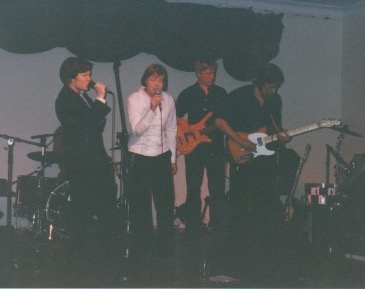
We all wanted to create another album. Everyone agreed that I would be the musical leader of the band and produce the new album. In return I would make sure the musical interests of every member would be taken into account. In addition to lead vocals, I also started to play the keyboards which I think was a role that suited me. After some time also Riikka joined the band to share the lead vocals and sing some choirs with me.

Compared to the Utopia Perfection lineup, this new Discordia was different. With the new guitarist Sande the new material had gotten much heavier with sound. The rock playing of the band was tight and excellent. I got great kicks from the playing right away. With Sande there were all of a sudden 3 composing members in the band. Like before, it was fascinating to collaborate on the compositions. Most often I took the riffs of the guitarists, put them into some structure and created the vocal melodies and rhythms, along with new textures and polyphonic lines. The album Season Changes ended up having 7 songs: I collaborated on 3 songs with Antti Tolkki and 3 songs with Sande and 1 song was purely mine: Grip!

I remember starting to compose Grip! — which ended up being arguably my longest and greatest progressive rock piece. Yes, I was very thrilled with playing of the band and the idea of having two excellent guitarists was very inspiring. I already knew the playing of Petri and Otto (and the singing of Riikka and myself) so Grip! was all about creating something challenging, rewarding and awe-inspiring specifically for this very band.

So my starting point for the song was the dialogue of the two heavy guitars, separated in the stereo picture. I perceived them kind of the same way as two antiphonal string sections of the symphony orchestra. Add to the picture the melodic bass playing and my keyboards which included rock organ, strings and piano, and the vocal harmonies, and Otto´s versatile and high energy drum playing, there we had the basic ingredients. I felt that here was a band that could execute my wildest rock and roll and progressive rock dreams. So I went for it!

For Strive or Warp my focus and ambition was strongly related and attached to classical music. Season Changes album was my return to rock. So is the 13 minutes long Grip!. It was all about the pure enjoyment of rock playing, energy and sound. Think about the repeated build-up chord progression of the finale part: E minor, G major, B major and C major. No classical note leading, oh no! Just the pure enjoyment of lifting the chords up and up like blocks with raw distorted guitar arpeggios. And to have choirs on top of it eventually, mixed with trills… I love it!

Then again it is also obvious that the long form was heavily influenced by classical music. The work is set in a kind of mixture of the sonata and variation form — plus also the Sibelian “rotation form” introduced by James Hepokoski comes to mind. I perceive traits of all the 3 forms in the work. There are multiple elements I rotate into focus time and time again in a different light along the 13 minutes of the work. For example the main theme is first introduced on the guitars and later reintroduced as a choral canon for the middle section and in the end sung by the lead vocalists.

Another important element of Grip! is the lyrics. When I started to compose and write the piece, I had some health issues. At first it was not clear for me or the doctors what caused these strange sensations of the nervous system but it felt like I was loosing physical control of my body. It felt like sinking into sometimes total physical insecurity where I doubted the functioning of my body. The lyrics are about me trying to get a grip and also for the first time having to face my own mortality and trying to deal with it.

In the end a benign tumour was found and operated. I haven´t had a single panic attack or strange sensation since the operation. But the experience of the sensations in my nervous system was absolutely awful and I cannot really explain what it felt like. Something about the panic and the experience can indeed be heard in Grip!. I think these lyrics are amongst my best. I feel like I have expressed something existential both musically and lyrically.

Like in many of my works there are strongly contrasting elements and ambitions juxtaposed in Grip!. The pure joy and energy of rock is set against the anxiety and expression of the lyrics. It is a strange combination. It is creates a picture of an individual doing his absolute best in trying to figure out what is happening and to regain a control of his life.

Musically Season Changes is completely different from Utopia Perfection, I think. Utopia Perfection was more ironic and tongue in cheek 70´s glam prog rock. There was no glam in Season Changes, it was much heavier and it was way more serious. It is no wonder that some people highly prefer the first album and some people highly prefer the later album. I for one cannot decide and neither do I have to. But Grip! sure is my best rock song of all time. I am immensely proud of it. Also the band has always been proud of pulling it off and learning all the 107 pages of the complicated partiture — and they should be! It was a wonderful thing to achieve together and everybody´s work, skill and insight was needed and put to use.

Pretty much like the previous time, after finishing Season Changes I already had plans and material for the next album and I started to push for it. Musically I just couldn´t stop… Not everyone are hardwired that way. So inevitably after Season Changes the band rather soon disbanded all together. The recording was a great achievement and it was great fun but it was too much for people who eventually wanted more the fun and social part of it all (the others) than the musically immensely ambitious part of it (me). Nevertheless I continued the collaboration with Sande and Riikka for one more progressive rock album during which I already started to sense that maybe my times with progressive rock were about to be over. That is the subject of chapter VII.

Path of a Composer Chapter II: Kilpilaulu

Welcome on a journey! I call it the Path of a Composer. The idea is to post key pieces of my music from along the years and hopefully put some light on how I have developed aesthetically, in my craftsmanship and of course also artistically — resulting in these days where I am finally ready to proudly launch myself as a composer of modern art music. It is time for Chapter II.

Waehnen: Kilpilaulu (demo from year 2002)
For alto, flute, clarinet, bassoon, viola and piano

“Who are we?” presented on the previous chapter was an example of my art rock which first of all was significant in guiding me to the fascinating idea of trying to become a composer of art music and later encouraging me to spread my wings. I cannot remember the whole thought process with all it´s phases but we do have a document of my first composition of Western art music and I am proud to share it with you on this blogpost.

Kilpilaulu was composed on the poem by the author Eeva Kilpi. I called her on the phone and asked for a permission which she gave me. The first idea was to compose three of these songs on her poems but I ended up composing only one. When I told Eeva I was to compose “Kuolema, ota minut käsivarsillesi” (Death, lift me in your arms), she said something like: “Oh, that is a very sad one”. Indeed. Nowadays “Kilpilaulu” is the name of the song because I have always referred to it by that name rather than with the longer title of the poem.

I had listened to a lot of classical and modern art music until then but never had I dared to try myself before this song. Yet, having studied in Musiikkiopisto (a Finnish music school system) ever since 1986, I of course knew how to read and write music. I had done a lot of exercises during my general musical studies. Also, I had tens and tens of poprock songs behind me already — and that has to count for something. So technical matters weren´t really an obstacle, I remember that. Now that I think of it, it truly must have been inevitable that I took up the task of the art music in the end.

I remember it was musically an immensely gorgeous and liberating experience to compose Kilpilaulu! It felt just great to create this kind of music of my own, to deal with something so essential. The feeling of being completely free was also so satisfying. That´s what art music still is for me, foremost: a medium where you don´t have to care about the limits of a genre. Now that I have a look at the song, it seems that the instrumentation and expression through it came to me very naturally. Listening to the demo, it feels as though I was at home with this kind of music from the start, despite certain technical aspects that I would do differently now that I have all the experience.

What were the starting points for the composition? Well there are many of them in fact. One of them was of course the extremely impactful poem before which there was none of the music. The second starting point is strongly linked to the first: I was going through a rather serious burnout while composing this song and it in fact resulted in me dropping out of Sibelius Academy and changing to Helsinki Yliopisto. It was the turning point in my life: until those years I had been an artistically oriented young fellow who subconsciously tried to please everyone and spread his focus all over, even musically. It was in those very same days that I decided to drop everything unnecessary from my life and focus on the essential. And I am still happily on that path! The powerful poem and composing it to music in fact helped me express the anxiety I was going through and as such get over my burnout. I emerged from that crisis much stronger, eventually really knowing who I am. So this song is a significant personal document to me — it still reminds me of paths not to take, it reminds me that I have to respect myself and live the kind of life that foremost suits me before anyone else. Only that way can I be of help and joy to others.

The 3rd starting point for Kilpilaulu must of course be musical. The influence of the expressive and intimate 4th Symphony by Sibelius is obvious. The flute high up against the slow note of the bassoon starts off the whole song. Very Sibelian gesture, right? Il Tempo Largo. Another influence is Tchaikovsky´s 6th Symphony, Symphonie Pathétique, in B minor. Yes, when I was going through the hard times the 4th by Sibelius and Tchaikovsky´s Pathétique were crucial. I remember thinking that there isn´t such a pain in the world that music could not express. As a kind of homage, the main melody sang by the soloist starts in augmented B minor — the key of the Pathétique. It couldn´t have been any other key.

When it comes to the technical aspects of composition, I decided to trust my heart, intuition, experience and ears. It seems that even on this first song I found something essential to myself: I like to slide seamlessly from tonality to modality to chromaticism to microtonality — expression showing the way and being the primary goal. The first three categories are present in this song, the 4th only as a kind of acoustic play where the piano doubles on the 5th of the bassoon (octave and a fifth higher, referring to a powerful overtone). Anyway, even to this day I refuse to limit my musical means in order to please some aesthetic school. I can be very tonal and traditional and very modern, new-searching and dissonant if I choose so. This has stayed the same throughout the years.

Also the strong aim at coherence is still present in my compositions and it is obvious in Kilpilaulu as well. There are a few musical motives which are developed along the way. That´s what I have always admired in Sibelius: organic growth of the music. I aimed at the same in this song. That results in that the music seems to make sense. Then again it is not something that I would have to meticulously work at — I think for me it is a basic quality of music to build on what has been before. That I am strongly Sibelian and Beethovenian is at the core of my musical being. The balance between cohesion, diversity, expression and strong contrasts is still at the core of my composing.

What about the aesthetics from the viewpoint of today? Well, if I were to compose the piece today, I would fix certain things, and a few places would be different. There is some naivety to be spotted, at least for me. Then again I value the genuine atmosphere of the piece — there is none of the technical showing off that is something composers need to consciously work against, me included. In the end if the music communicates, is genuine and makes an impact, that is all you can ask of a composition.

The demo was recorded at Sibelius Academy and performed by my fellow students. I did nothing but produced and guided the rehearsing and recording process. It was a studio live with some overdubs. I remember that for some of my fellows recording the piece was kind of hard because the poem and the music is so full of anxiety. We were young but all of a sudden there was something very serious indeed to be performed. Anyway, I think everyone did a great job! I have to mention especially Laura Miettinen, who also sang on Chapter I “Shistavich: Who are we?”, but in the style and aesthetics of popular music. It is interesting to hear how the aesthetics differ. I love her voice and performance in both works.

How to sum it all up? For me Kilpilaulu was crucial in that it allowed me to put into music my experience of the burnout which was the biggest crisis of my life until then and even today one of the 2 crises I have gone through. I realised that there is nothing that music could not express and I live in that conviction even today. Also, it really is my first piece of modern western art music. Despite the certain naivety or bare/primitive expression, I seem to have found my musical voice in art music straight away. Such experiences have a lasting effect even though my journey was to take many turns. The seed was planted so to speak although I was not ready to give up rock of which I had so many years of experience.

The Path of a Composer Chapter III will address how I continued to train composing art music yet by accident found progressive rock which combined art music and rock and through which I was able to express the musical duality within myself for many years whilst letting the art musician in me slowly grow.

Path of a Composer Chapter I: Shistavich — Who Are We?

Welcome on a journey! I call it the Path of a Composer. The idea is to post key pieces of my music from along the years and hopefully put some light on how I have developed aesthetically, in my craftsmanship and of course also artistically — resulting in these days where I am finally ready to proudly launch myself as a composer of modern art music. It is time for Chapter I.

Shistavich – Who Are We? (Demo from year 2001.)

Shistavich was a band formed by a bunch of students mostly at the Sibelius Academy. It was based on my art songs, the powerful vocals of Laura Miettinen and the excellent playing and arrangements of guitarist Harri Kentala, bass player Osmo Ikonen and drummer J Salonen.

When Shistavich was formed, I already had some experience in rock bands. It all started with a grunge band Jubilee Club (1993-1995) in which I sang vocals and played the bass guitar. My first real songs were composed for the band — although I had improvised on the piano and by singing basically my whole life until then. In high school I had a band ugFish and that´s when my compositions started to head to the direction of art rock. That was mostly due to me truly finding classical music and especially Sibelius and Beethoven in 1996 on my exchange year in Australia.

What do I recall about “Who Are We?” and how is it typical of my art rock? Well, from the very beginning my compositions were based on chord progressions with bass lines and vocals on top, put to strong rhythms. I did all of this on the piano, singing. “Who are we?” is representative of the same tradition. Also from the beginning until those days I communicated my songs with chord sheets, without writing the melodies in detail but rather singing them with the lyrics to the vocalist. I also communicated the rhythms and the basic beat to the band for a starting point by playing the piano. As far as I remember in this instance I wrote in notes only the background harmonies for the studio work.

The chord progressions of “Who are we?” are in fact rather complex. At that time I often occupied myself with harmonic progressions that made the song constantly transpose it´s key. This song is a prime example of that. The listener might not even be aware of that it starts in A minor after which it transposes regularly in minor thirds: A minor to C minor to Eb minor and finally to ending in F# minor.

What are the connections to classical music? Well I think my roots in classical music can be heard in my pianism. Also the chords chosen, the way I combine the chords to each other and the tone leading do reflect classical music. This song is not particularly polyphonic in texture but I hear polyphonic thinking behind the music: it is spread between all the instruments and the vocals and it makes the music smooth, despite the intensive harmonies. Could I have composed this music without playing the classical piano and having learned about the classical tone leading and chord progressions? Nope.

One key feature typical to me as a composer that is also present in “Who Are We?” is the importance of the melody. There were (somewhat naive) times when I even valued and ranked songs and even instrumental classical music primarily on their melodies — and that is the reason why I demanded a lot from my own melodies. The song is very melodic indeed. Another key feature of mine is the demand of expression and drama. The listeners must always feel that I have given them something of significance. I work on my music as long as it takes to achieve the status where I can convincingly say: “Yes, I have expressed something meaningful and other people can probably get something from this.”

Lyrics in English is something I have done ever since Jubilee Club. I consider myself a decent writer in Finnish as I have been writing short stories and am in the middle of writing my first novel. But I must be honest: I have no true ability of evaluating the quality of my lyrics in English to any objectivity. What I can say is that in the lyrics of “Who Are We?” I have expressed my deep love for nature and described my long walks in the ancient Finnish forests wondering about the human life and the occasional insanity of living in a busy city as part of the immensely complex society. The song is about the basic question of life as stated by a person in his early 20´s.

“Who are we?” was undoubtedly included in the top 5 songs of the Shistavich band. I also consider it one of my best art rock songs and even today I am perfectly happy with it. Nevertheless, quite soon after this song the band started to move towards more funk, blues, R&B and roots type of aesthetics. Coming from the dichotomy and union of Rock & Classical myself, I didn´t feel at home with the direction the band and the arrangements were taking although I of course liked everything the great band did. Yet I have joked that there is absolutely NO GROOVE in me as a composer and musician. 😉 So inevitably Shistavich disbanded rather soon after that — luckily there was no drama at all included.

By the way, I talked to all the members of Shistavich before this blog post! They listened to the song and liked it even today. Many of the members of Shistavich are prominent full time musicians in Finland today.

The end of Shistavich also coincided with the time that I for the first time thought that maybe I should start composing art music myself. Classical music had slowly become the most important genre of music in my life but it took a long time before it even crossed my mind that maybe I could start composing it myself. Looking back, without Shistavich and all the feedback I would not have found my strengths as a composer or my identity — at least not as quickly.

It is in fact fascinating to think that before “Who Are We?” I had never composed a single piece of western “classical” or modern art music. The Path of a Composer Chapter II will let you hear my first ever composition of western modern art music.

I hope you enjoy the song!